-
Video lessons for intermediate level
Grammatical Cases in Croatian & Serbian
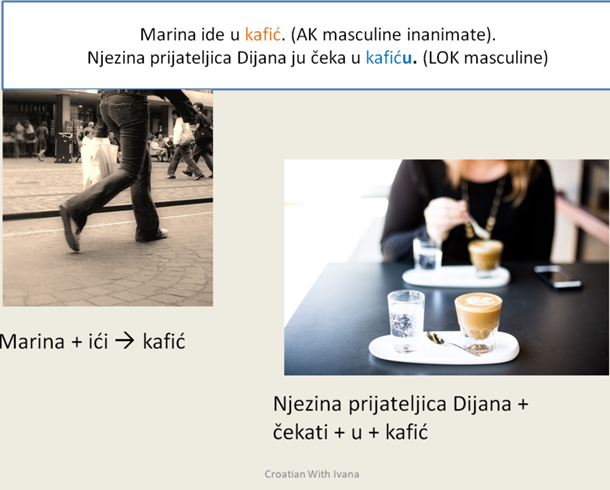
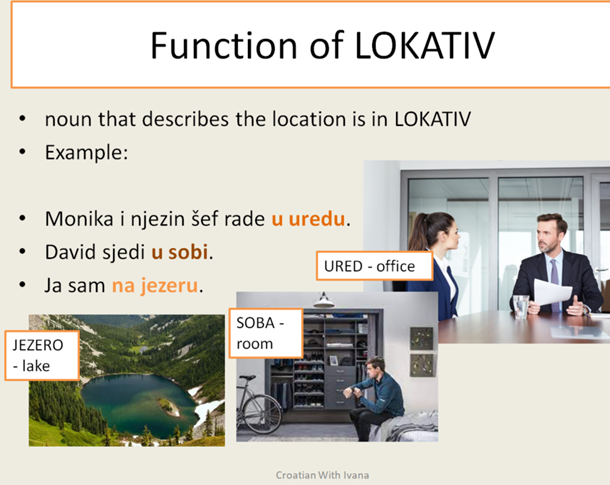
When speaking about places, you can use lokativ, but also akuzativ. See which is that important difference!

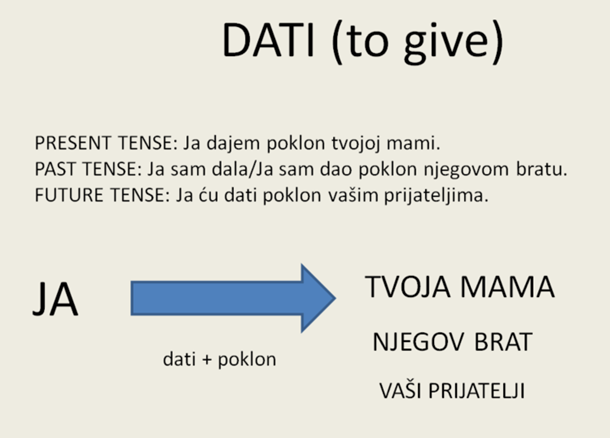
Just like its name says – dativ (dati – to give) – is used when addressing a recipient – literally or figuratively. Look at the examples in the video.

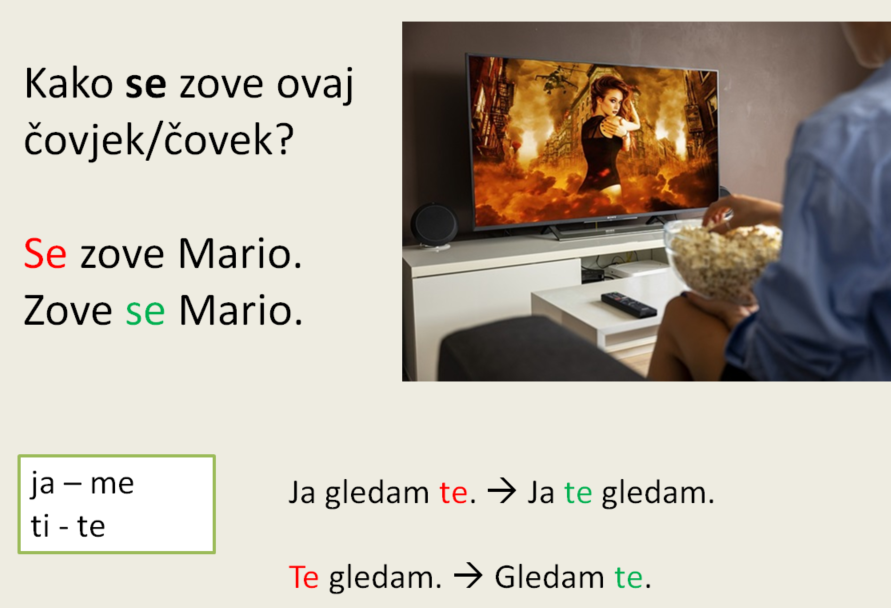
Order in the sentence
Learn how to order the words in the sentence depending on their function.
-
Intermediate Grammar Exercises
Practice the grammar with exercises and quizzes for B1 and B2 levels.
B1 Exercises
DATIV & VERBS THAT COME WITH IT
VERBS – PERFECTIVE & IMPERFECTIVE; OTHER TENSES
COLLECTIVE NOUNS – VRATA, DJECA/DECA, BRAĆA
B2 Exercises
COMBINE ALL THE CASES AND TENSES
MU, GA, JU, JOJ… PERSONAL PRONOUNS IN DIFFERENT CASES
PRACTICE USING ADJECTIVES AND NOUNS IN DIFFERENT CASES
-
Video lessons for beginners
Croatian & Serbian Basics
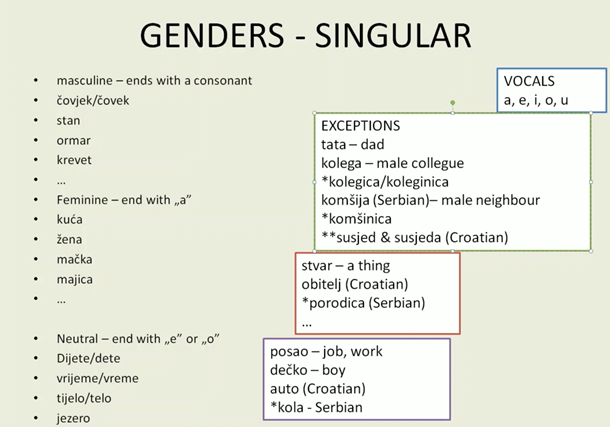
Noun Genders in Singular and Plural + Adjectives & Possessive Pronouns
Learn how to recognize the gender of every noun and how to change the adjectives and possessive pronouns to match the noun gender.
Grammatical Tenses in BCSM languages
Learn how to form the present, past and future tense through the conversation.
Grammatical Cases in Serbo-Croatian
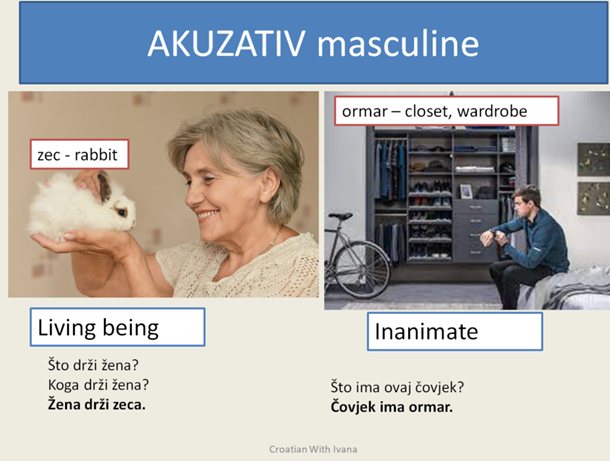
Learn the functions and see many examples of using the akuzativ in BCSM languages.
Learn when to use this grammatical case and how to apply it in a sentence.
-
Beginner Grammar Exercises
Find the quizzes to practice the grammar of the A1 and A2 levels.
A1 Exercises
A GOOD START IS HALF DONE: Practice the basic phrases when introducing someone and having the first small talk.
HOW TO DESCRIBE THINGS CORRECTLY? Make sure you know how to handle adjectives, like velik, mali, lijep/lep and similar; as well as possessive pronouns such as moj, tvoj, njegov etc.
YOUR FIRST CASES: Having 7 cases, it’s challenging to remember all those suffixes, but practicing step by step, it’s more than possible. I recommend beginning with the most used cases – AKUZATIV and LOKATIV.
YOUR FIRST TENSE: In learning any language, the best is to begin with the present tense when it comes to tenses. BCMS languages have only one present tense. You can use it for describing your routine, current statements (what are you doing right now) and even promises.
LET’S CONTINUE WITH THE CASES: Practice expressing company and transportation.
PRACTICE MAKING QUESTIONS: question words (Tko, što/šta, kada, kako…)
A2 Exercises
WHOSE IS IT? Practice on how to make the adjectives from the names (like John’s, Mary’s…) or make construction with 3 words (like my sister’s friend) by using genitiv case.
“IT IS BETTER THAN…” Practice comparing things and people.
LET’S CONTINUE WITH THE TENSES: After practicing the present tense, it’s time to improve other tenses – the past tense called “perfekt” and future tense (futur).
DATES AND YEARS
MAKE THE SENTENCES: After you’ve practiced the most important cases and all the tenses, it’s time to learn how to structure the sentences. These exercises could help!
-
Svršeni i nesvršeni glagoli
You must be logged in to view this content.
Log in here.
If you don’t have an account, choose the best membership plan for you and register!
-
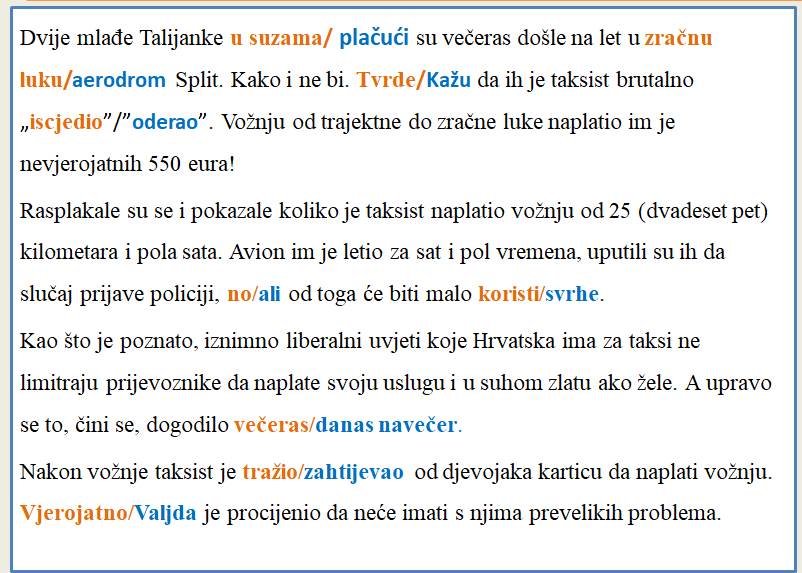
Talijankama naplatio 550 eura vožnju od 25 kilometara
ONLY CROATIAN VERSION
Transcription
Translation – Prijevod
Two younger Italian girls arrived at the flight at the airport Split in tears. How wouldn’t they. They claim that the taxi driver has brutally “squeezed them out”. He charged an unbelievable 550 euros for the ride from the airport to the ferry port.
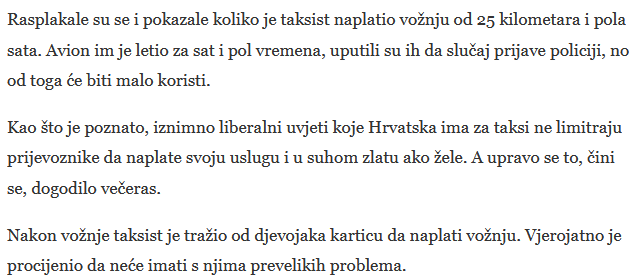
They started to cry and showed how much the taxi driver had charged for their ride of 25 km and half an hour. Their plane had flown in an hour and a half, they had been told to report the case to the police, but it will be of little use.
As it’s familiar, extremely liberal conditions that Croatia has for the taxi don’t limit the transporters to charge their service “like dry gold” if they want. And just that, it seems, happened this evening.
After the ride, the taxi driver asked for a credit card of the girls to be able to charge the ride. Probably, he estimated that he won’t have too big problems with them.
Analysis – Analiza
- Što je to “iscjedio”?
It has a metaphorical meaning here. Literally, it means “squeeze out”, so when you say “kako me iscjedio/iscjedila”, it means that a vendor or someone who sold you something charged a lot. “Sqeezed” would be your feeling then. Like a lemon in the picture below.
2. Što znači “naplatiti” vs. “platiti”?
Platiti translated to English is to pay and naplatiti means to charge.
Example:
Bio/bila sam na kavi u kafiću.
Platio/platila sam (JA) 2 eura. = KONOBAR mi (meni) je naplatio 2 eura.
We can say the same in two ways, with two similar but still different verbs.
3. Naplatiti/platiti u suhom zlatu
Suho zlato literally means dry gold. It means something precious but with no real value necessary.
Just like in the text.
The taxi driver charged the ride a lot but it shouldn’t cost so much. So he – naplatio je u suhom zlatu.
We can reverse the situation, too, and say that Italian girls – Talijanke su platile u suhom zlatu.
A vi? Jeste li ikad platiti nešto u suhom zlatu? 😉
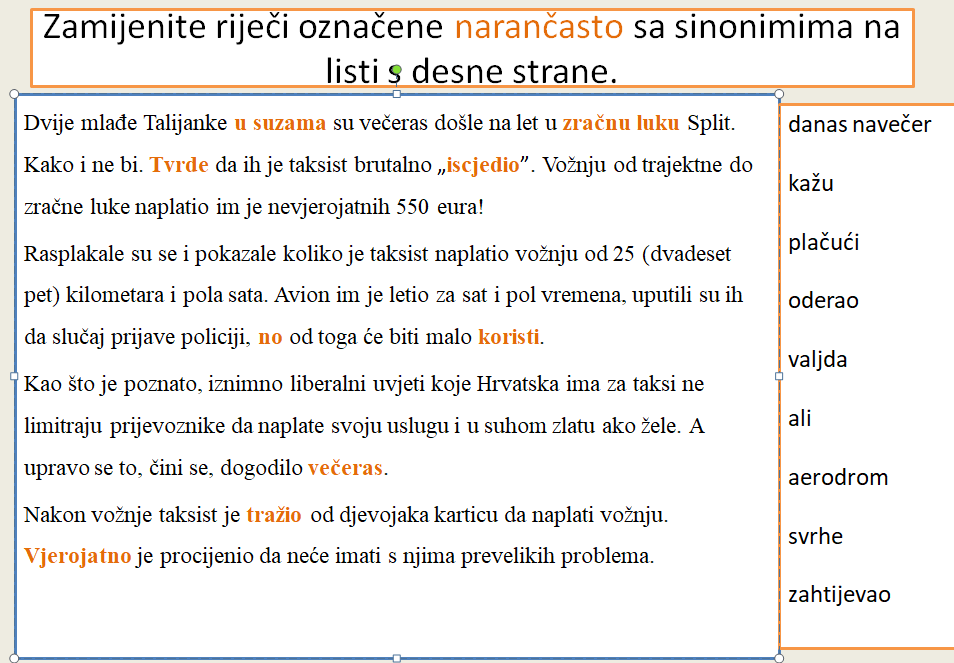
Exercise – Zadatak
Let’s do an interesting exercise related to the text.
Check the correct answers in the section below.
Answers – Rješenja
P.S. Znate li što znači “oderao”?
It is also one expression that is used in the same context as “iscjedio”. Literally, it means to remove the skin from an animal. Sounds brutal in the literal meaning. However, it’s mostly used in the metaphorical meaning, like in the text and in that case, people don’t even think about the literal meaning. It sounds neutral and means that you paid too much.
-
Dativ – video lesson
You must be logged in to view this content.
Log in here.
If you don’t have an account, choose the best membership plan for you and register!
-
2 where – lokativ or akuzativ
You must be logged in to view this content.
Log in here.
If you don’t have an account, choose the best membership plan for you and register!