Jučer sam bila u gradu i vidjela sam bivšeg šefa, ali on nije vidio mene. Išla sam u kafić. Naručila sam kavu s mlijekom i sjela za stol. Čitala sam knjigu kad me sestra zvala na mobitel: „Jesi li vidjela šefa? Ušao je u kafić gdje si ti.“ – rekla mi je. „Kako znaš?“
Znala je jer je radila u centru grada, u uredu na petom katu. Gledala je centar grada i vidjela ljude koji su šetali, djecu koja su vozila bicikl i, također, mene i šefa.
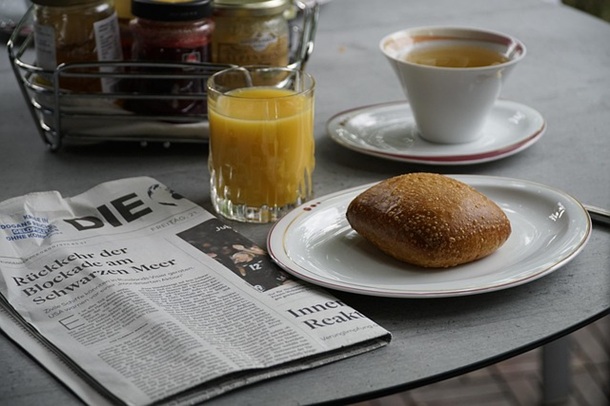
U tom trenutku sam ga ugledala. Sjedio je pored prozora. Čitao je novine, ali nije pio ništa. Samo je jeo kroasan. Onda je ustao i uzeo je kavu za van. Uh, zrak je čist. Tada sam ustala i ja (također) i izašla iz kafića.
VOCABULARY
dogoditi se – to happen
jučer – yesterday
bivši – ex
kafić – cafe, coffee shop
naručiti – to order
mlijeko – milk
sjesti – to sit
stol – table
čitati – to read
knjiga – book
zvati – to call
ući (ušao) – to enter, to come in
reći (rekla) – to tell, to say
gledati – to watch
vidjeti – to see
šetati – to go in walk
trenutak – moment
ugledati – to see, to notice
prozor – window
novine – newspaper
piti (pio) – to drink
jesti (jeo) – to eat
onda – then
kava za van – coffee to go
zrak – air
čist – clean
tada – then
SERBIAN VERSION
Question
Time’s up
Transcription – SRB
Cyrillic
Ево шта се десило јуче.
Јуче сам била у граду и видела сам бившег шефа, али он није видео мене. Ишла сам у кафић. Наручила сам кафу с млеком и села за сто. Читала сам књигу кад ме сестра звала на мобител: „Да ли си видела шефа? Ушао је у кафић где си ти.“ – рекла ми је. „Како знаш?“
Знала је јер је радила у центру града, у канцеларији на петом спрату. Гледала је центар града и видела људе који су шетали, децу која су возила бицикл и, такође, мене и шефа.
У том моменту сам га угледала. Седео је поред прозора. Читао је новине, али није пио ништа. Само је јео кроасан. Онда је устао и узео је кафу за понети. Ух, ваздух је чист. Тада сам устала и ја (такође) и изашла из кафића.
Latin
Evo šta se desilo juče.
Juče sam bila u gradu i videla sam bivšeg šefa, ali on nije video mene. Išla sam u kafić. Naručila sam kafu s mlekom i sela za sto. Čitala sam knjigu kad me sestra zvala na mobitel: „Da li si videla šefa? Ušao je u kafić gde si ti.“ – rekla mi je. „Kako znaš?“
Znala je jer je radila u centru grada, u kancelariji na petom spratu. Gledala je centar grada i videla ljude koji su šetali, decu koja su vozila bicikl i, takođe, mene i šefa.
U tom momentu sam ga ugledala. Sedeo je pored prozora. Čitao je novine, ali nije pio ništa. Samo je jeo kroasan. Onda je ustao i uzeo je kafu za poneti. Uh, vazduh je čist. Tada sam ustala i ja (takođe) i izašla iz kafića.
VOCABULARY
десити се /desiti se – to happen
јуче / juče – yesterday
бивши / bivši – ex
кафић / kafić – cafe, coffee shop
наручити / naručiti – to order
млеко / mleko – milk
сести / sesti – to sit
сто / sto – table
читати / čitati – to read
књига / knjiga – book
звати / zvati – to call
ући (ушао) / ući (ušao) – to enter, to come in
рећи (рекла) / reći (rekla) – to tell, to say
гледати / gledati – to watch
видети / videti – to see
шетати / šetati – to go in walk
моменат / momenat– moment
угледати / ugledati – to see, to notice
прозор / prozor – window
новине / novine – newspaper
пити (пио) / piti (pio) – to drink
јести (јео) / jesti (jeo) – to eat
онда / onda – then
кафа за понети / kafa za poneti– coffee to go
ваздух / vazduh– air
чист / čist – clean
тада / tada – then
Translation
Evo što se dogodilo jučer. / Evo šta se desilo juče.
Here’s what happened yesterday.
Jučer sam bila u gradu i videla sam bivšeg šefa, ali on nije video mene.
Yesterday I was in town and I saw my ex-boss but he didn’t see me.
Išla sam u kafić. Naručila sam kavu/kafu s mlijekom/mlekom i sjela/sela za stol/sto.
I went to the cafe. I ordered a coffee with milk and I sat at the table.
Čitala sam knjigu kad me sestra zvala na mobitel:
I was reading a book when my sister called me on mobile phone:
„Jesi li vidjela/Da li si videla šefa? Ušao je u kafić gde si ti.“ – rekla mi je. „Kako znaš?“
“Did you see your boss? He entered the cafe where you are.” – she told me. “How do you know?”
Znala je jer je radila u centru grada, u uredu/kancelariji na petom katu/spratu.
She knew because she worked in the center of the town, in the office on the 5th floor.
Gledala je centar grada i vidjela/videla ljude koji su šetali, djecu/decu koja su vozila bicikl i, takođe, mene i šefa.
She was watching the town center and saw people who were in walk, kids who were riding bike, and also, me and my boss.
U tom trenutku sam ga ugledala.
At that moment I saw him.
Sjedio/Sedeo je pored prozora. Čitao je novine, ali nije pio ništa.
He was sitting next to the window. He was reading the newspaper but he didn’t drink anything.
Samo je jeo kroasan. Onda je ustao i uzeo je kafu za poneti.
He was eating croissant only. Then he got up and took coffee to go.
Uh, zrak/vazduh je čist. Tada sam ustala i ja (takođe) i izašla iz kafića.
Oh, the air is clear. I got up then, too, and got out of the cafe.
Analysis
This story is narrated in the past tense. In Croatian and Serbian, the same grammar construction is used for all the past tense forms that exist in English and other languages. What is called in English “past simple” (Ex. I did) and “past continuous” (I was doing), in Serbo-Croatian is the same construction.
However, there is little difference between these two forms. It’s something we call “perfective” (simple) and “imperfective” (continuous) forms but about this later. Now let’s see how to form the past tense.
It’s formed from two parts. The first part is the present tense of the verb “to be”. It’s the first you learned probably. I’ll remind you:
ja
sam
ti
si
on, ona
je
mi
smo
vi
ste
oni, one
su
This is the first part. The second part is formed the way:
you have an infinitive. For example: raditi
remove – ti from the infinitive. It left: radi
put one of the suffixes:
o – for masculine
la – for feminine
lo – for neutral
li – for plural (only masculine or masculine and feminine mixed)
le – for plural (only feminine)
EXAMPLES
If you’re a man and you want to say: Yesterday I worked, you’d say:
Jučer, ja sam radio.
If you’re a woman, the same sounds:
Ja sam radila.
In both cases, the first part is “sam” because it refers to “ja” but the second part changes due to the person’s gender.
Therefore, we can see that the narrator of our story is a woman because it says:
CRO: Jučer sam bila u gradu i vidjela sam bivšeg šefa…
SRB: Juče sam bila u gradu i videla sam bivšeg šefa…
But when talking about her boss, who is a man, it’s used another form: On je vidio/video
The same is with the second person singular – ti. When you talk with someone, will you use masculine form (example: Šta si radio?) or feminine form (Šta si radila?) depending on if the person is a man or woman, boy or girl.
In the PLURAL, there are two options depending on people’s genders, too.
If you’re a man and you’re in a group of only men, men and women or even only women, you’ll always say: Mi smo radili.
But if you’re a woman, you will say “Mi smo radili” if there are only men or men and women in your group. If there are only women, you will say: Mi smo radile.
The same works for “vi”. For “oni”, it’s always radili and for “one” – radile.
EXAMPLES
The same rule about the past tense applies to any other verb whose infinitive ends with -ti. Let’s see the examples from the text:
Naručila sam kavu/kafu s mlijekom/mlekom…
Čitala sam knjigu kad me sestra zvala na mobitel… (when we have “me” and “te” in the sentence, it’s not needed to use “je”, but it’s not incorrect, so you can add it: kad me je sestra zvala.)
Znala je jer je radila u centru grada…
Gledala je centar grada…
…ljude koji su šetali, djecu/decu koja su vozila bicikl… (djeca/deca as a collective noun is specific – first part is adjusted to plural, which “djeca/deca” are in reality, but the second part is adjusted to its grammatical gender, and it’s feminine)
U tom trenutku sam ga ugledala. Sjedio/Sedeo je pored prozora. Čitao je novine, ali nije pio ništa. Samo je jeo kroasan. Onda je ustao i uzeo je kavu/kafu za poneti.
Tada sam ustala i ja…
NOTE that we can not literally translate the past tense, like: Ja sam radila – I am worked. These two parts of the past tense are translated together, as one part. In English past simple – I worked or past continuous – I was working – depending on the context.
NEGATION IN THE PAST TENSE
…ali on nije video mene. — Here you can see how to make a negation in the past. Only negate the first part:
Ja nisam radila, ti nisi radio, mi nismo radili, etc.
VERBS -JETI/ETI GROUP
As seen in the first sentence, the verbs of -jeti in Croatian and -eti group in Serbian form the past tense the same way as all the verbs whose infinitives end with -ti, like raditi, gledati, slušati…
However, in Croatian, these verbs are different a little bit only in masculine form. Instead of:
On je vidje-ti –> vidjeo
The correct form is:
On je vidio (“je” changes to “i”)
The same will be:
živjeti – Ja sam živio.
željeti – Ti si želio.
But it’s only in masculine form and in Croatian.
In Serbian, the infinitive ends with -eti so it’s always regular:
videti –> vide-ti –>On je video, ona je videla, mi smo videli…
živeti –> Ja sam živeo, ona je živela, oni su živeli…
VERBS -ĆI GROUP
The next sentence in the text shows an example of how to make the past tense from the verbs that end with -ći in the infinitive form, like:
ići (to go), ući (to enter, to come in), izaći (to go out/to leave), doći (to come), naći (to find) and more.
The rule is that you remove the last “i”, change “ć” with “š” and then put the suffixes:
ao – for masculine
la – for feminine
lo – for masculine
li – for plural
le – for plural feminine
These are actually the same suffixes we use with the verbs that end with -ti, only the masculine form is a little bit different (-ao instead of only -o):
Ušao je u kafić… (UĆI)
Let’s see other examples of -ći verbs in the past tense from the text:
Išla sam u kafić. (IĆI)
Tada sam ustala i ja i izašla iz kafića. (IZAĆI)
Exceptions are a few verbs of -ći group:
reći (to tell) – rekao, rekla, rekli Ušao je u kafić gdje/gde si ti.“ – rekla mi je.
peći (to bake) – pekao, pekla, pekli
obući se (to get dressed) – obukao, obukla, obukli
moći (to be able) – mogao, mogla, mogli
pomoći (to help) – pomogao, pomogla, pomogli
VERBS -STI GROUP (JESTI & SJESTI/SESTI)
These verbs lose the last -sti before adding the suffixes:
Naručila sam kavu/kafu i sjela/sela za stol/sto. – SJESTI/SESTI
Samo je jeo kroasan. – JESTI
QUESTIONS IN THE PAST TENSE
And the last we need to learn about the past tense is how to make questions.
CROATIAN
-long form of the first part:
Ja sam radila.
The long form of “sam” is “jesam”. The same is with the rest:
ti jesi, mi jesmo, vi jeste, oni jesu. The exception is: on, ona je (stays short).
Jesi + li + radila + ? Jesi li radila? (Did you work?)
Je li on radio? or Je li radio?
Jeste li radili?
Jesu li radili?
With QUESTION WORDS, it’s used the short form: Što si radio? Što si radila? Gdje ste pili kavu? Kada je Marko jeo doručak?
SERBIAN
In Serbian, just put the phrase “da li” in the beginning:
Da li si radio? Da li si jela? Da li ste pili kafu?
Order of the past tense parts
In the past tense, we also don’t need to use the pronouns (ja, ti, on, ona…) if it’s not necessary. We can remove them but then, just reverse two parts of the past tense:
Sam išla – incorrect
Išla sam – correct
You can do the same with other -ći group verbs. Examples:
Došao sam na posao u 8. ( I came to work at 8)
Našli ste moj mobitel! (You guys found my mobile phone! or You guys have found my mobile phone – present perfect in English is also translated with the past tense in Croatian and Serbian)
Learn: akuzativ – the most important grammatical case, possessive pronouns (my, your,his, her…); possessive adjectives
CROATIAN VERSION
Questions
Time’s up
Transcription – CRO
Ana ide u školu, ali mama ju pita: Što imaš u torbi?
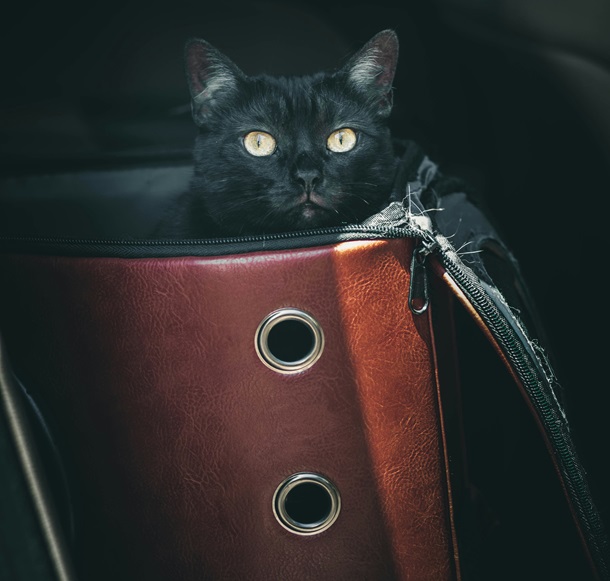
Ništa, kaže Ana, ali iz torbe se čuje: Mjauu.
Zapravo, kaže mama, koga imaš u torbi?
ANA: No dobro, imam mačku.
MAMA: Čija je to mačka?
ANA: To je moja mačka.
MAMA: Tvoja mačka? Mi imamo samo psa.
ANA: To nije naš pas. To je djedov pas.
MAMA: No dobro, djedov i bakin pas, nema veze. To je isto kao da je tvoj ili moj pas. Ali čiju mačku imaš u torbi?
ANA: Ma… to je susjedova mačka.
MAMA: Mačka našeg susjeda Davida?
ANA: Ne, mačka njegove žene Sabine.
MAMA: To je Sabinina mačka? Joj, moraš odmah vratiti mačku! Sabina je luda!
ANA: Ne, želim ići u školu s mačkom.
MAMA: Ne budi luda, pusti mačku, to je tuđa mačka.
VOCABULARY
torba – bag
zapravo – actually
koga – who in akuzativ form
no – well
mačka – cat
čiji, -a, -o; -i – whose
to – that
pas – dog
nema veze – never mind
isto– the same
vratiti – to give back
lud, -a, -o – crazy
ne budi luda – don’t be crazy
pustiti – to let, to leave
tuđa – someone’s else
SERBIAN VERSION
Questions
Time’s up
Transcription – SRB
Cyrillic
Ана иде у школу, али мама ју пита: Шта имаш у ташни?
Ништа, каже Ана, али из ташне се чује: Мјауу.
Заправо, каже мама, кога имаш у ташни?
АНА: Но добро, имам мачку.
МАМА: Чија је то мачка?
АНА: То је моја мачка.
МАМА: Твоја мачка? Ми имамо само пса.
АНА: То није наш пас. То је дедин пас.
МАМА: Но добро, дедин и бакин пас, нема везе. То је исто као да је твој или мој пас. Али чију мачку имаш у торби?
АНА: Ма… то је комшијина мачка.
МАМА: Мачка нашег комшије Давида?
АНА: Не, мачка његове жене Сабине.
МАМА: То је Сабинина мачка? Јој, мораш одмах да јој вратиш мачку! Сабина је луда!
АНА: Не, желим да идем у школу са мачком.
МАМА: Не буди луда, пусти мачку, то је туђа мачка.
Latin
Ana ide u školu, ali mama ju pita: Šta imaš u tašni?
Ništa, kaže Ana, ali iz tašne se čuje: Mjauu.
Zapravo, kaže mama, koga imaš u tašni?
ANA: No dobro, imam mačku.
MAMA: Čija je to mačka?
ANA: To je moja mačka.
MAMA: Tvoja mačka? Mi imamo samo psa.
ANA: To nije naš pas. To je dedin pas.
MAMA: No dobro, dedin i bakin pas, nema veze. To je isto kao da je tvoj ili moj pas. Ali čiju mačku imaš u tašni?
ANA: Ma… to je komšijina mačka.
MAMA: Mačka našeg komšije Davida?
ANA: Ne, mačka njegove žene Sabine.
MAMA: To je Sabinina mačka? Joj, moraš odmah da joj vratiš mačku! Sabina je luda!
ANA: Ne, želim da idem u školu sa mačkom.
MAMA: Ne budi luda, pusti mačku, to je tuđa mačka.
VOCABULARY
ташна / tašna– bag
зашраво / zapravo – actually
кога / koga – who in akuzativ form
но / no – well
мачка / mačka – cat
чији, -а, -о / čiji, -a, -o; -i – whose
то / to – that
пас / pas – dog
нема везе / nema veze – never mind
исто / isto– the same
вратити / vratiti – to give back
луд, -а, -о /lud, -a, -o – crazy
не буди луда / ne budi luda – don’t be crazy
пустити / pustiti – to let, to leave
туђа / tuđa – someone’s else
Translation
Ana ide u školu, ali mama ju pita: Što/šta imaš u torbi/tašni?
Ana goes to school, but her mom asks her: What do you have in your bag?
Ništa, kaže Ana, ali iz torbe/tašne se čuje: Mjauu.
Nothing, says Ana, but there comes a sound from the bag: Meow.
Zapravo, kaže mama, koga imaš u torbi/tašni?
Actually, says mom, whom do you have in your bag?
ANA: No dobro, imam mačku.
ANA: Well okay, I have a cat.
MAMA: Čija je to mačka?
MOM: Whose cat is that?
ANA: To je moja mačka.
ANA: That’s my cat.
MAMA: Tvoja mačka? Mi imamo samo psa.
MOM: Your cat? We have only a dog.
ANA: To nije naš pas. To je djedov/dedin pas.
ANA: That’s not our dog. That’s grandpa’s dog.
MAMA: No dobro, djedov i bakin pas, nema veze. To je isto kao da je tvoj ili moj pas. Ali čiju mačku imaš u torbi/tašni?
MOM: Well okay, grandpa’s and grandma’s dog, never mind. That’s the same like he’s your or my dog. But whose cat do you have in your bag?
ANA: Ma… to je susjedova mačka.
ANA: Ehh… that’s our neighbor’s cat.
MAMA: Mačka našeg susjeda Davida?
MOM: Our neighbor David’s cat?
ANA: Ne, mačka njegove žene Sabine.
ANA: No, his wife Sabina’s cat.
MAMA: To je Sabinina mačka? Joj, moraš odmah vratiti mačku! Sabina je luda!
MOM: That’s Sabina’s cat? Oh, you have to give the cat back immediately! Sabina is crazy!
ANA: Ne, želim ići u školu s mačkom.
ANA: No, I want to go to school with the cat.
MAMA: Ne budi luda, pusti mačku, to je tuđa mačka.
MAMA: Don’t be insane, leave the cat, that’s a stranger’s cat.
Analysis
AKUZATIV of PRONOUNS
We learned how the nouns change in akuzativ form – when you have a direct object in the sentence.
Mama pita Anu.
Ana pita mamu.
And when we use the pronouns to avoid repeating the same noun, we also need to decline the pronoun.
Ana ide u školu, ali mama ju pita: Što imaš u torbi?
Ana ide u školu, ali mama pita Anu. → Instead of repeating Ana again, we put the pronoun “ona” but in akuzativ form. “Ona” in akuzativ sounds “ju”.
Here’s masculine and neutral form – ga.
Marko ide u školu, ali mama ga pita. (Marko is going to the school but mom is asking him.)
Ti – Ti ideš u školu, ali mama te pita. (You are going to the school but mom is asking you.)
Mi – Mi idemo u školu, ali mama nas pita. (We are going to the school but mom is asking us.)
Vi – Vi idete u školu, ali mama vas pita. (You guys are going to the school but mom is asking you.)
Oni, one – Oni idu u školu, ali mama ih pita. (They are going to the school but mom is asking them.)
Koga, što/šta?
Not only the pronouns but we need to change the question word who adjusting it to akuzativ.
That’s why we CAN NOT say:
Tko imaš u torbi? / Ko imaš u tašni?
Meaning Whom do you have in your bag? But we need to change tko/ko to akuzativ form:
Koga imaš u torbi/tašni?
When using the word što/šta, it doesn’t change in akuzativ.
Što imaš u torbi? / Šta imaš u tašni? – Imam mobitel.
What do you have in your bag? – I have my mobile phone.
Čiji, čija, čije?
Here’s one more question word that means whose – čiji.
But this is masculine form. That means you use it with a masculine word:
Čiji je to pas?
But with feminine word, it change to čija – Čija je to mačka?
In the neutral form, it’s čije – Čije je to dijete/dete?
In the plural, it’s again čiji – Čiji su to psi? Or Čije if we talk only about females – Čije su to mačke?
And it can be declined – Ali čiju mačku imaš u torbi? → Here we have a verb that requires akuzativ – imati – so we changed “čija mačka” to akuzativ form.
EXPRESSING POSSESSION
Here’s how to explain whose is something or someone – how to express ‘s (neighbour’s, Philip’s, Ana’s…)
If the person who possesses it is male, add – ov (bratov, Filipov)
If the person is female, add – in (Ana → Anin, mama → mamin)
No dobro, djedov i bakin pas, nema veze.
NOTE!
If we have a word that signifies a male person in reality but it’s feminine grammatically, such as – deda, komšija, kolega – we put the feminine suffix – in.
Example: To je komšijina mačka.
When the object of possession is a feminine word, put “a” at the end:
Susjed + ov + a mačka
Mam(a) + in + a mačka
But in masculine, it’s not needed : susjed + ov pas, mam(a) + in pas
And did you notice akuzativ form of “pas”? – It’s psa, not pasa – “a” is removed.
“Genitiv way” of expressing possession
Mačka našeg susjeda Davida
Here is one more way how to express possession – by using genitiv. Use it when you have 3 words (my mom’s dog – moja mama + pas) while the suffixes described above are used when you have two words (neighbour’s dog – susjed + pas → susjedov pas)
Here’s how to use genitiv:
My mom’s dog:
Moja mama + pas
Pas + moja mama in GENITIV → pas moje name
Just like in the text: mačka njegove žene Sabine
This is feminine, and now the masculine form is:
Pas mojeg susjeda.
We use genitiv for even more that 3 words
His wife Sabina’s cat → mačka njegove žene Sabine
Bolded is all in genitiv
POSSESSIVE PRONOUNS
We learned how to make possessive adjectives and now let’s review possessive pronouns:
[Yes, some forms are the same – neutral singular and plural feminine, but we get the difference from the context: moje dijete/dete – my child, moje mačke – my cats]
Your – tvoj, tvoja, tvoje; tvoji, tvoje
To je isto kao da je tvoj ili moj pas. (pas is a masculine word)
*To je moja mačka. (mačka is a feminine word so the pronoun “moj” gets the suffix -a)
His – njegov, njegova, njegovo; njegovi, njegove
Her:
Croatian: njezin, njezina, njezino; njezini, njezine
Do you recognize what “mu”, “joj”, “ju”, ga” and other short strange words mean? Do you know how to use them in sentences? Try out! Practice declining personal pronouns here.